Question bank 25,000+
The largest EPPP bank available, split across quizzes, mock exams and mastery modules. Every item carries a written explanation, not just a correct letter.
PassEPPP starts by measuring where you stand across all nine domains — then adapts your roadmap to your achievement gaps. All materials and content curated by our editors and licensed teachers.
Free membershipNo card requiredUpgrade when ready
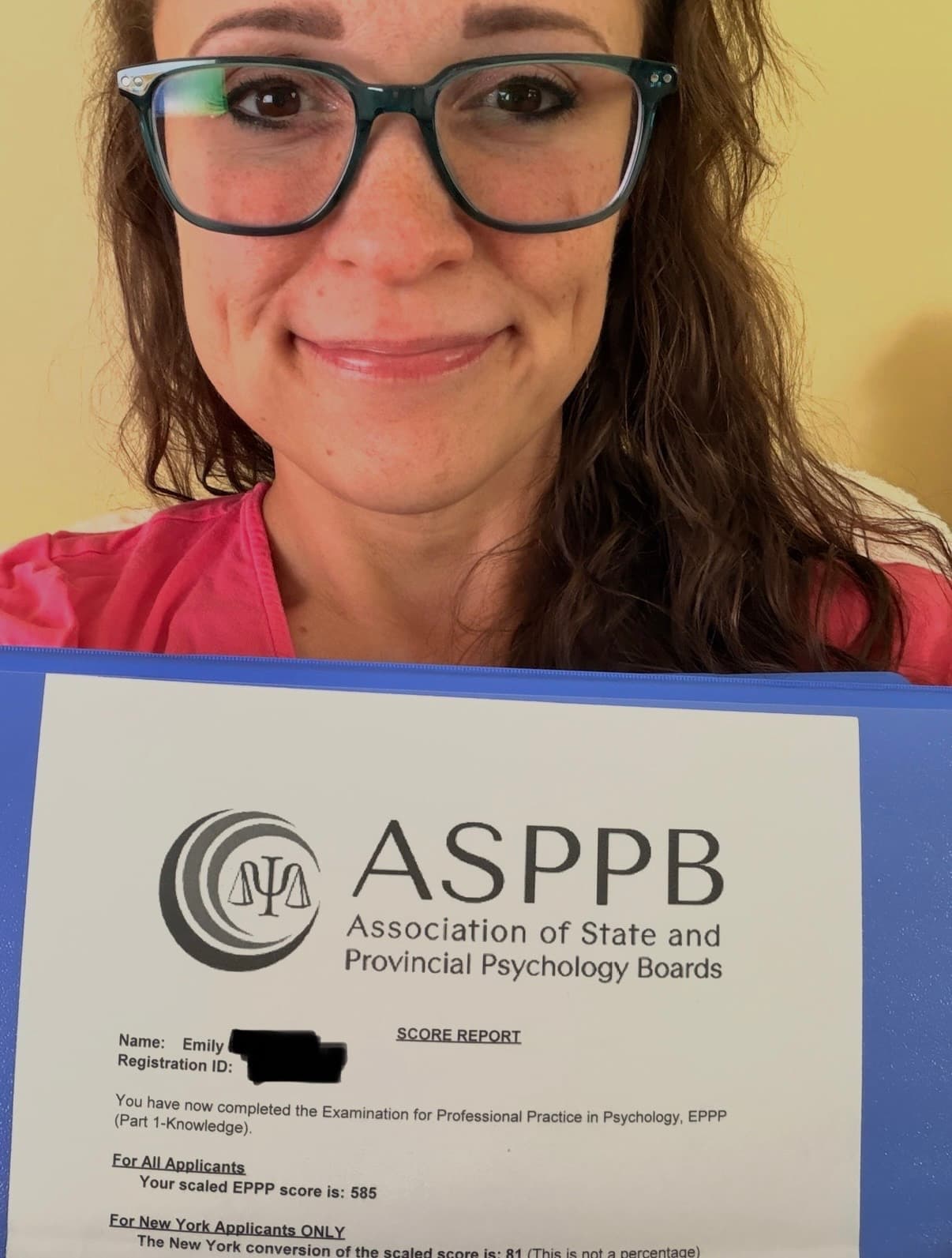
As someone who has been out of clinical psychology for over ten years, I was unsure that I would be able to successfully pass the EPPP on my first attempt.
I signed up for Pass EPPP and another platform when I was approved to take the exam. Pass EPPP allowed me to practice my study material with the great interactive components on their website, the brain simulation, along with their thousands of practice EPPP questions.
I have no doubt that taking the quizzes helped me get used to the EPPP material and successfully pass on my first try! I would absolutely recommend Pass EPPP to anyone who is preparing for this difficult exam.
The EPPP does not reward time spent. It rewards coverage. So the whole program runs one loop, and it does not let you skip the uncomfortable part.
A full 225-question mock exam, timed and scaled exactly like the real one. You get a scaled score and a mastery figure for all nine domains before you study a single page.
Your weakest areas get queued first. Lectures, textbook chapters, flashcards and quizzes are all assigned against the gap, not against a generic week-by-week calendar.
Assigned, not browsedSit the next mock. If the area moved, it drops down the queue. If it did not, it comes back harder. You keep going until every area sits clear of the pass line, not just the total.
20 mocks · no repeatsEverything below is written in-house and updated for the 2026 exam. Nothing here is a retired item bank bought from someone else.
The largest EPPP bank available, split across quizzes, mock exams and mastery modules. Every item carries a written explanation, not just a correct letter.
Full-length, 225 questions, timed and scaled. Built on the ASPPB blueprint weightings.
On demand, in English, Spanish and French. One topic per video, so you can watch just the gap.
Ten lectures of two three-hour sessions each, curated by our editors and aligned to the EPPP exam.
Full text with quizzes built into each chapter and vocabulary review as you read.
Spaced repetition across every chapter and content area. Cards you miss come back sooner.
Mastery radar, score history, growth trend and the gap list that drives your queue.
3D brain pathology, patient encounters and streak challenges. Covered in detail below.
Biological bases is where most candidates lose points, and it is the hardest area to learn from a list. So we built it as a thing you can turn around.
 Answers light up in the model
A patient with bilateral medial temporal calcifications can see faces and recognize most emotions, but has marked difficulty identifying fear from facial expressions. Damage to which structure best accounts for this selective deficit?
Six things move an EPPP score. Here is where we stand on each.
| Typical EPPP programs | PassEPPP | |
|---|---|---|
| Question relevancy | Outdated, irrelevant to the exam, or AI-made, too long and uncurated | Written in-house and checked against the handbook, quality and alignment of questions updated weekly, screened thoroughly by our team |
| Bank size | 2,000 to 5,000 items with only one mode of testing is common | 25,000+ itemsacross textbook quizzes, mock exams, and mastery modules, curated surgically by our editors & our licensed teachers |
| Mock exams | 1-7, often reusing the same question pool with limited topic scope | 20 full-length mock exams, EPPP-aligned testing breadth and depth |
| Lectures | Brief and unfocused lectures — outdated, English only, no tables | 10 domain lectures— two sessions 3 hours long, 60–100 slides; 250+ ~30-min topic lecturesin English, Spanish & French |
| What you're told after a mock | A total score, sometimes a domain percentage | Scaled score, mastery per area, and an assigned queue |
| Practice modes & other support | Overpriced physical flashcards and textbooks | Digital flashcards & textbook the instant you join, lectures, an interactive 3D brain pathology quiz, & daily text messages with Testers' Digest |
Competitor figures reflect publicly advertised features as of August 2026.
A lot of our members are on their second or third attempt. That is who this was built for.
I failed twice with other programs. This one was different. The lectures explained the why, not just the what.
Seeing exactly which areas were dragging me down changed how I studied. I stopped rereading things I already knew.
Third time was the charm. The mock exams were close enough to the real thing that exam day felt like a repeat.
A retake costs you the fee, the wait, and months of supervised hours you cannot bill.
The things people ask us most. If yours is not here, send us a message and a real person answers.
That is who most of our members are. A retake is where the diagnostic matters most, because you already know the total was short but not which areas cost you. Sit one mock, get the area breakdown, and study only the gaps. Most people on a second attempt do not need to relearn everything.
No, and we would not sell them if they were. Every item is written in-house, curated by our editors and licensed teachers, and checked against source material for textual overlap before it goes live. Retired items are copyrighted, and banks built on them go stale as the blueprint moves.
Most members who pass spend between six and fourteen weeks with us. The range depends on how much ground the diagnostic says you need to cover, not on a fixed schedule. Your queue shrinks as areas clear, so the finish line is visible from week one.
It is free and needs no card. You get a sample of each part of the program: a mock exam, quizzes, a topic lecture, flashcards, textbook chapters and a mastery module. You also get daily text messages with Testers' Digest. It is enough to judge the question quality, which is the only thing worth judging.
Yes. All 250+ topic lectures are available in English, Spanish and French.
Change or cancel any time from your account page. Changes take effect at your next billing date, and you keep access through the period you have already paid for.
Free membership, no card. Sit one mock exam and you will know exactly what is left to do.